

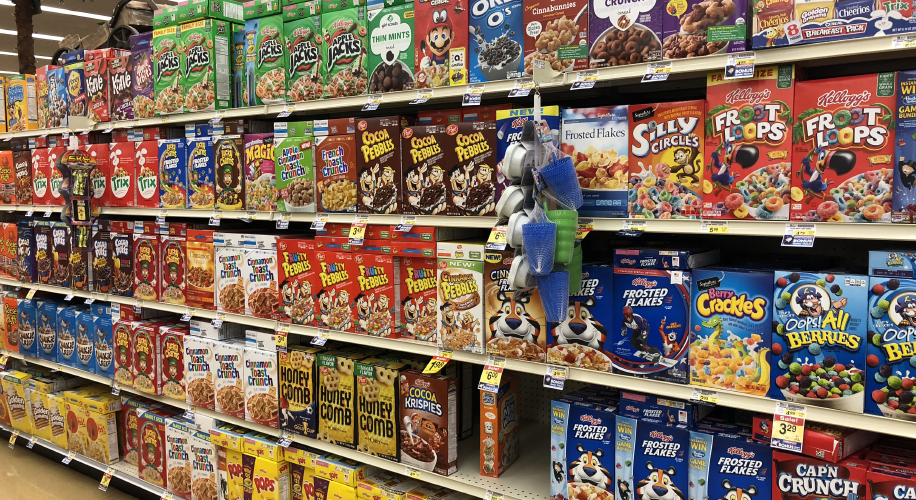
Froot loops. Frosted flakes. Marshmallow magic. Cap’n crunch. Has the world gone mad?
As a consumer, I find too much choice overwhelming. I don’t eat cereal, but the idea of an entire shopping aisle dedicated to sugary grains makes my head spin.
As a marketer, I see this kind of category proliferation and question its value to consumers. What happened to marketing first principles, where genuine customer needs are identified and served with differentiated products?
I find it hard to believe that there’s a qualified or quantified need for honey nut cheerios or chocolate lucky charms for breakfast. Yet both appear on these shelves. Getting brand cut-through in this environment must be hugely challenging for even the most talented FMCG marketing team. Not to mention the budget and resources required.
Of course, I’m picking on breakfast cereals to make a point but I could make the same observations about virtually any other category: fashion, computers, skincare, craft beer. And these are just physical world examples. In the virtual world, there are no shelf-space limits or distribution barriers to speak of. Instead, we have infinitely more ways to be distracted from making considered choices. Endless ads, promotions, 1-click buying, a multiplicity of influencers and celebrity endorsers. Where does it stop?
Variety may be the spice of life, but I can’t help feeling we’re getting things very wrong. Unfettered choice creates clutter, confusion and noise, online and off. And I’m sure it adds to anxiety levels that are already heightened by the incessant competition for our attention: pick me, like me, follow me, subscribe to me, buy me, keep up with me. It’s all too much.
Ask anyone in your circle if they feel a certain type of overwhelm from having too much stuff. My guess is that most people will say yes and that they need to declutter their lives and homes. We’ve created a monster and it’s called over-consumption.
No wonder the self-storage industry is booming. In the US alone, there is 2.3 billion square feet of available storage space. That equates to about three Manhattan Islands. That’s a lot of stuff, most of which is probably no longer wanted or needed, and possibly never was. And think about the money wasted on perennial self-storage rentals. Out of sight might be out of mind but it’s also out of pocket.
Don’t get me wrong. I’m all for consumer choice and it would be hypocritical of me to suggest that a brand shouldn’t bring new products to market. After all, I’m also an entrepreneur and have been there and done that with a line of performance martial arts uniforms. I might rationalize this by saying we’ve created a unique, high-quality product that serves a well-defined market niche, but the truth is it too exists in a crowded category.
Collectively, I think we need to be more discerning in our choices whether we are contributors to, or consumers of the materialism monster.
As business owners, product managers and marketers, we need to get back to basics. Is what we’re about to unleash on the world solving a genuine customer need or problem? Does it delight the customer and is it different, better, more sustainable – or is it something that’s likely to race its way to irrelevance and the landfill because it wasn’t really needed or wanted in the first place?
As consumers, we need to think about our role in creating a planet that’s heaving under the weight of stuff, and the environmental impact of unrestrained consumption. Are we engaging in mindless or mindful buyer behaviour? Do we really need to upgrade our smart phones every two years or fill our wardrobes with clothes or shoes we may only wear once, twice or possibly never?
The reality is, more stuff doesn’t make us any happier, more connected or inspired. And there’s plenty of research to prove it.
Let’s put a stop to the madness and learn to know when enough is enough.
 CALCO.